Standard Recurring
Overview
A standard (recurring) subscription is an ongoing subscription that automatically reorders and rebills on a set schedule — for example, every 3 weeks — and continues indefinitely until it's canceled or reaches an end date. This is the most common subscription type, and it gives the customer the most control: it can be paused, resumed, and skipped at any time while it's active.
This section outlines the statuses a standard subscription can occupy throughout its lifecycle and explains what causes it to move into each one. As described on the main overview page, a subscription's status is captured by two things that move independently:
- State — where the subscription sits in its lifecycle (Active, Paused, Canceled, or Inactive).
- Processing state — the health of the most recent order and payment attempt (Pending, Success, or Failed).
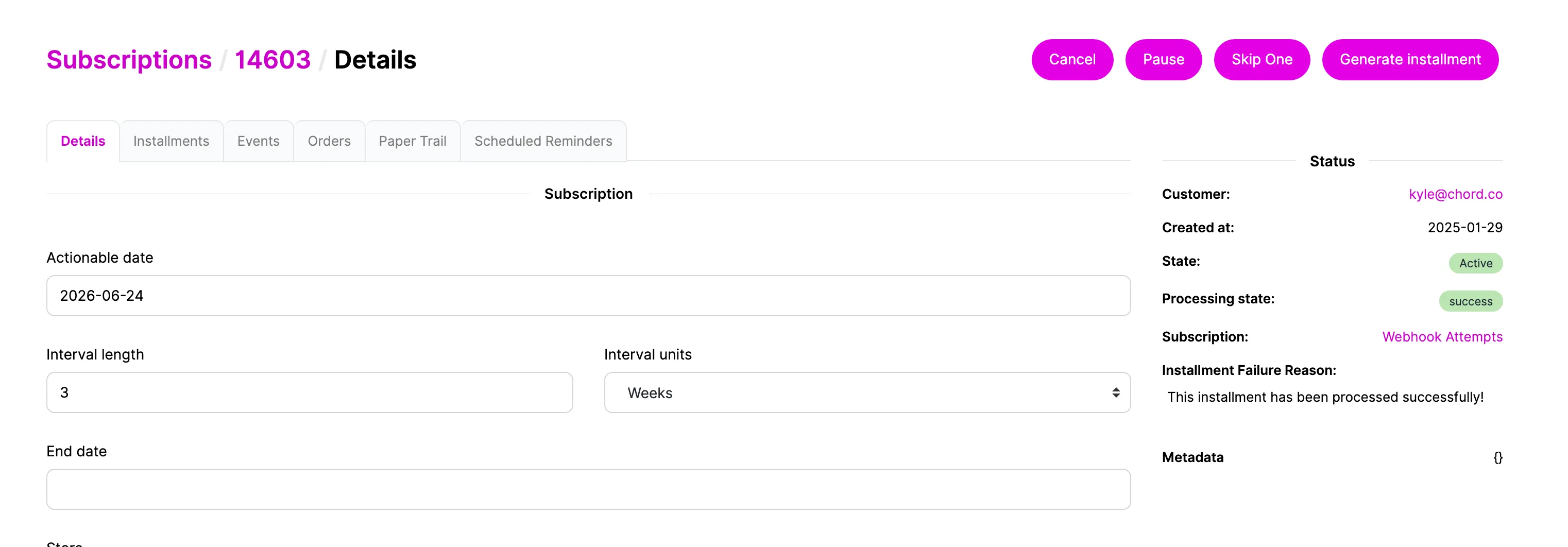
A standard subscription can use every State value, since it's the only type that can be freely paused, resumed, and skipped. The sections that follow walk through each State, what places a subscription into it, and how the customer or store moves it from one to the next.
State
A standard subscription moves through the following states over its lifetime. Each entry below explains what the state means and what causes a subscription to enter it.
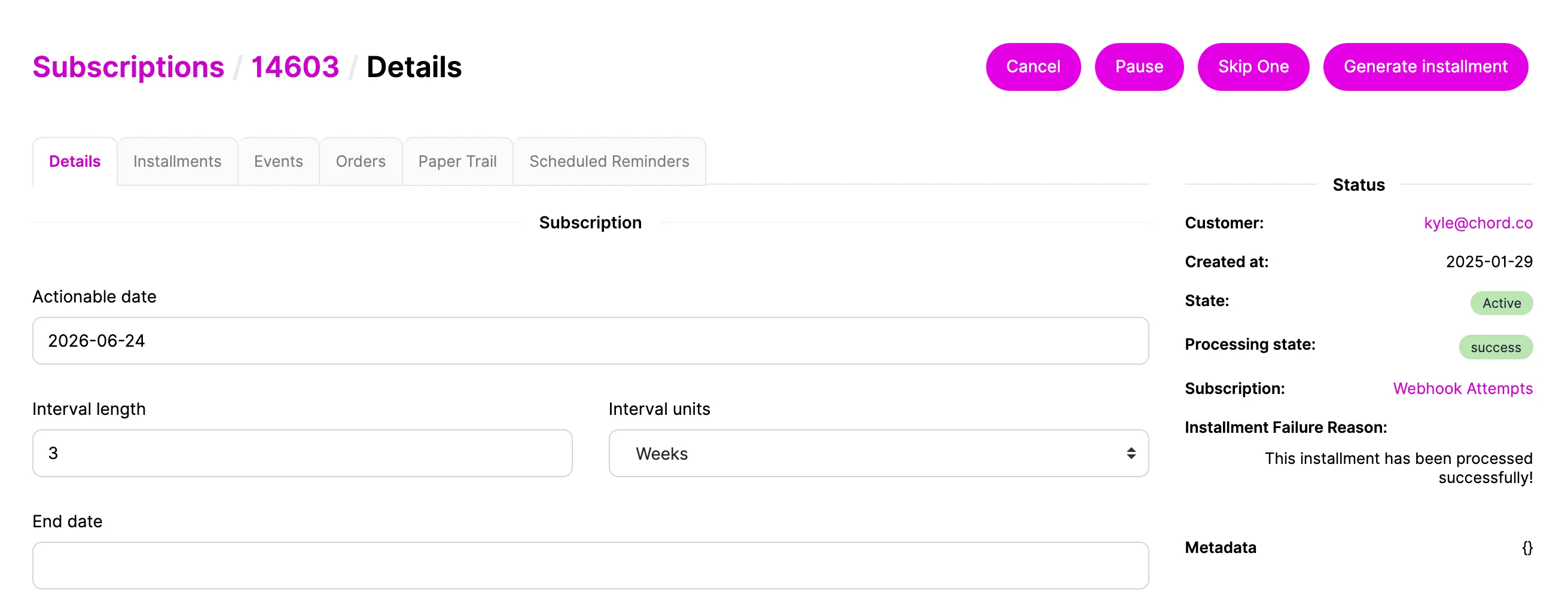
Active
The subscription is live and will place its next order automatically on the scheduled date. This is the normal, healthy operating state.
A subscription is Active when:
- It was just created — every subscription starts out Active.
- The customer skipped an upcoming order — skipping only pushes the next order date out by one cycle; the subscription stays Active throughout.
- A previously canceled subscription was reactivated.
Paused
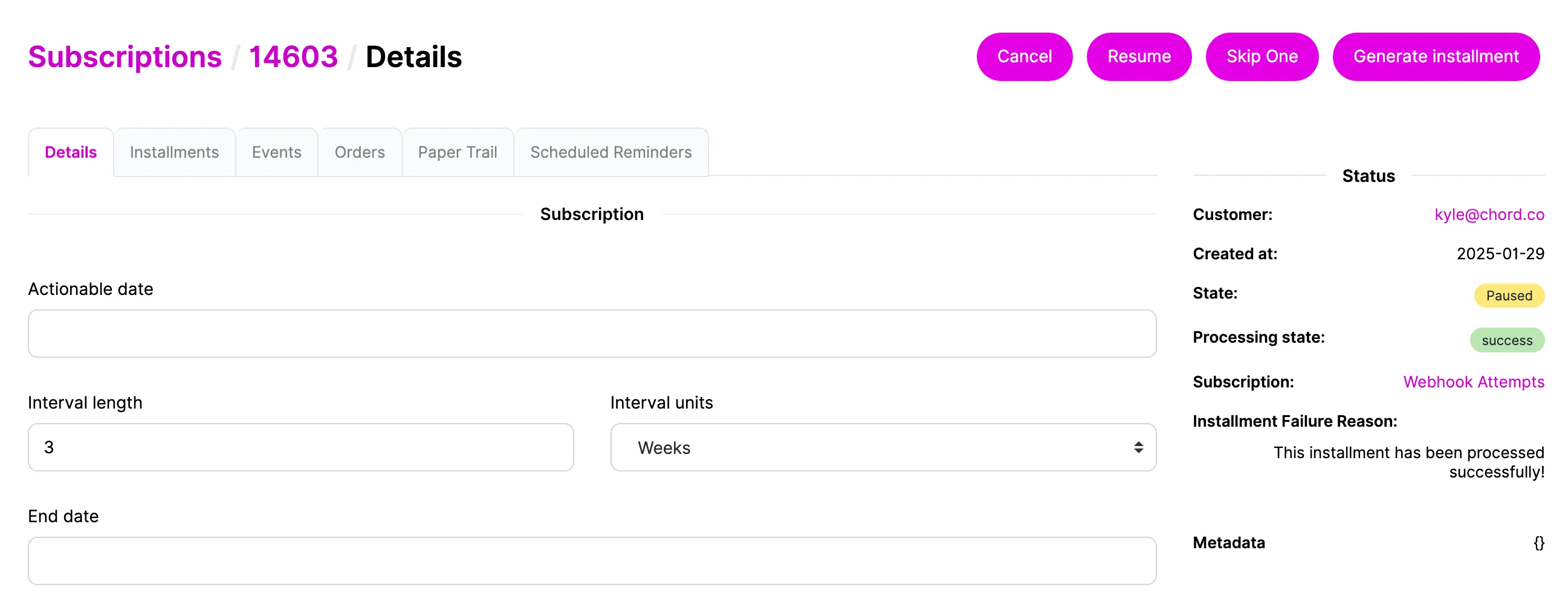
The subscription is active but has its upcoming orders temporarily on hold. No orders are placed and no charges are made while it's paused.
A subscription becomes Paused when:
- The customer or an admin uses the Pause action — this holds all upcoming orders until the subscription is resumed.
- A payment fails and automatic retries are turned off for the store.When a scheduled order's payment fails, the store's automatic retry setting determines what happens next:
- If automatic retries are turned on, the system reschedules the charge and tries again later, leaving the subscription Active. It only stops retrying — and cancels the subscription — once it exceeds the store's maximum number of retry attempts.
- If automatic retries are turned off, there is no retry. The system pauses the subscription on the very first failed payment, holding all future orders until it's resumed.
Resuming a paused subscription returns it to Active and schedules its next order date.
Note: Paused subscriptions are still Active. "Paused" isn't a separate stage in the subscription's lifecycle — it's an active subscription whose orders have simply been put on hold.
The status badge displays "Paused" so you can see at a glance that an active subscription is on hold. Because of this, only an active subscription can be paused (a canceled or ended subscription cannot), and resuming it returns the badge to "Active." Unlike Canceled or Inactive, which are final end states, a paused subscription is still live and waiting to be resumed.
Canceled
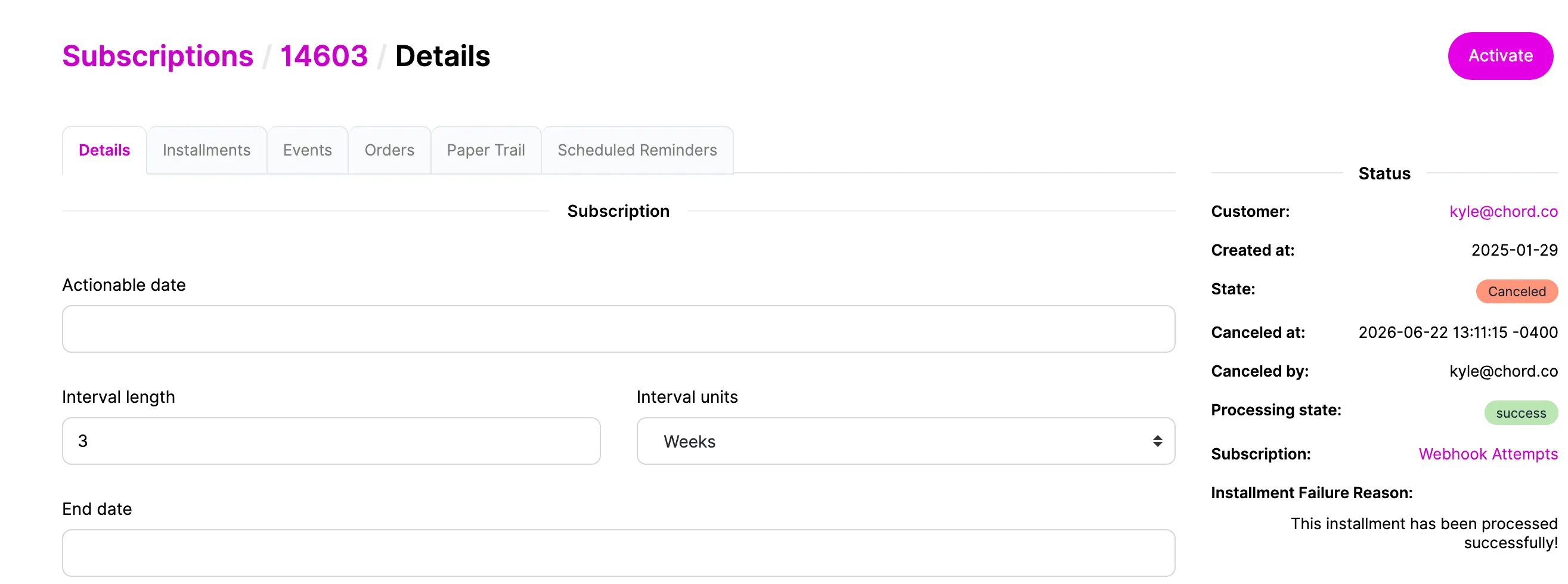
The subscription has ended early and will no longer place orders. This is a final state.
A subscription becomes Canceled when:
- The customer or an admin cancels it — this takes effect immediately and stops all future orders.
- It is automatically canceled after too many failed payments — if the store has automatic retries enabled and the subscription exceeds the store's maximum number of failed payment attempts, the system cancels it.
Inactive
The subscription has ended on its own — not canceled early — and will no longer place orders. This is a final state.
A subscription becomes Inactive when:
- It reaches its end date — if the subscription was set up with a fixed end date, it automatically ends once that date passes.
- An admin manually ends it.
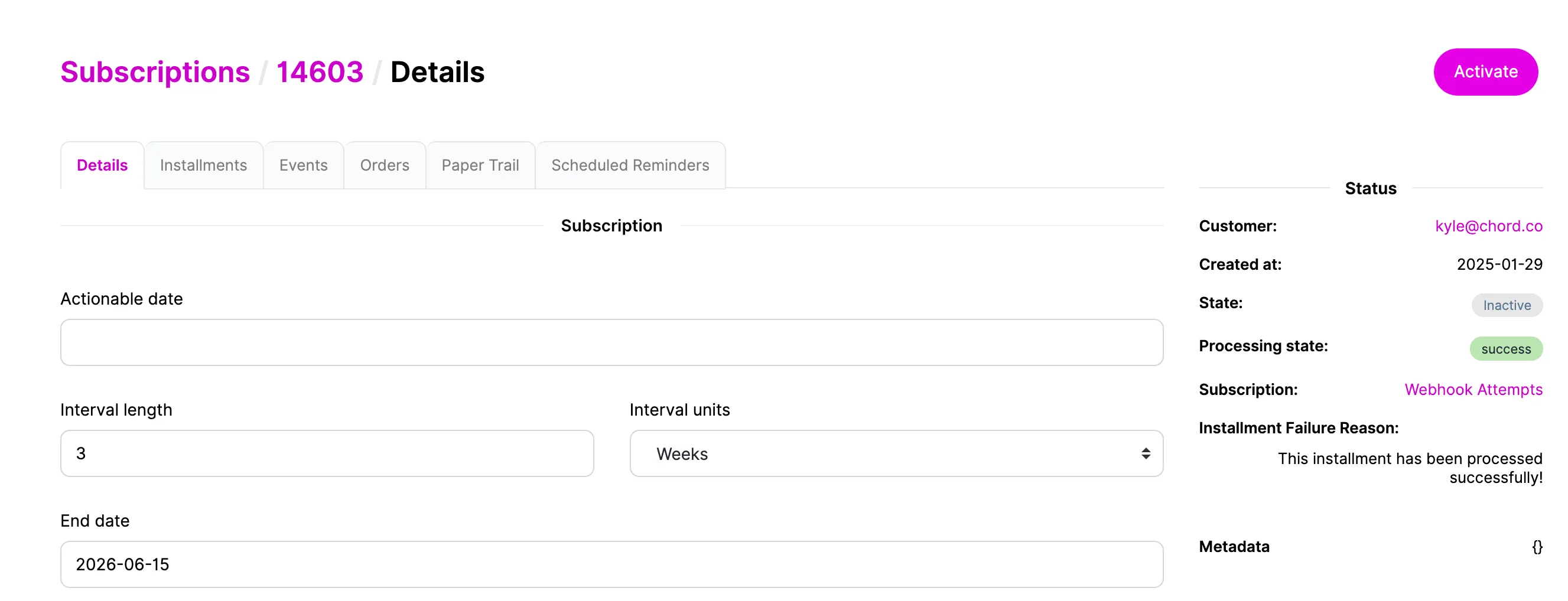
Note: A standard subscription only becomes Inactive if it has an end date. Open-ended subscriptions run indefinitely and never go Inactive on their own — they end only by being canceled.